

Izrada jasnih institucijskih politika i razvoj digitalnih kompetencija nastavnika ključni za digitalnu transformaciju ustanova u visokom obrazovanju
The traditional SRCE E-learning Centre Week was held online from 6 to 10 October 2025, enabling as many teachers as possible to acquire new knowledge and experience and to better prepare for high-quality teaching in the new academic year.
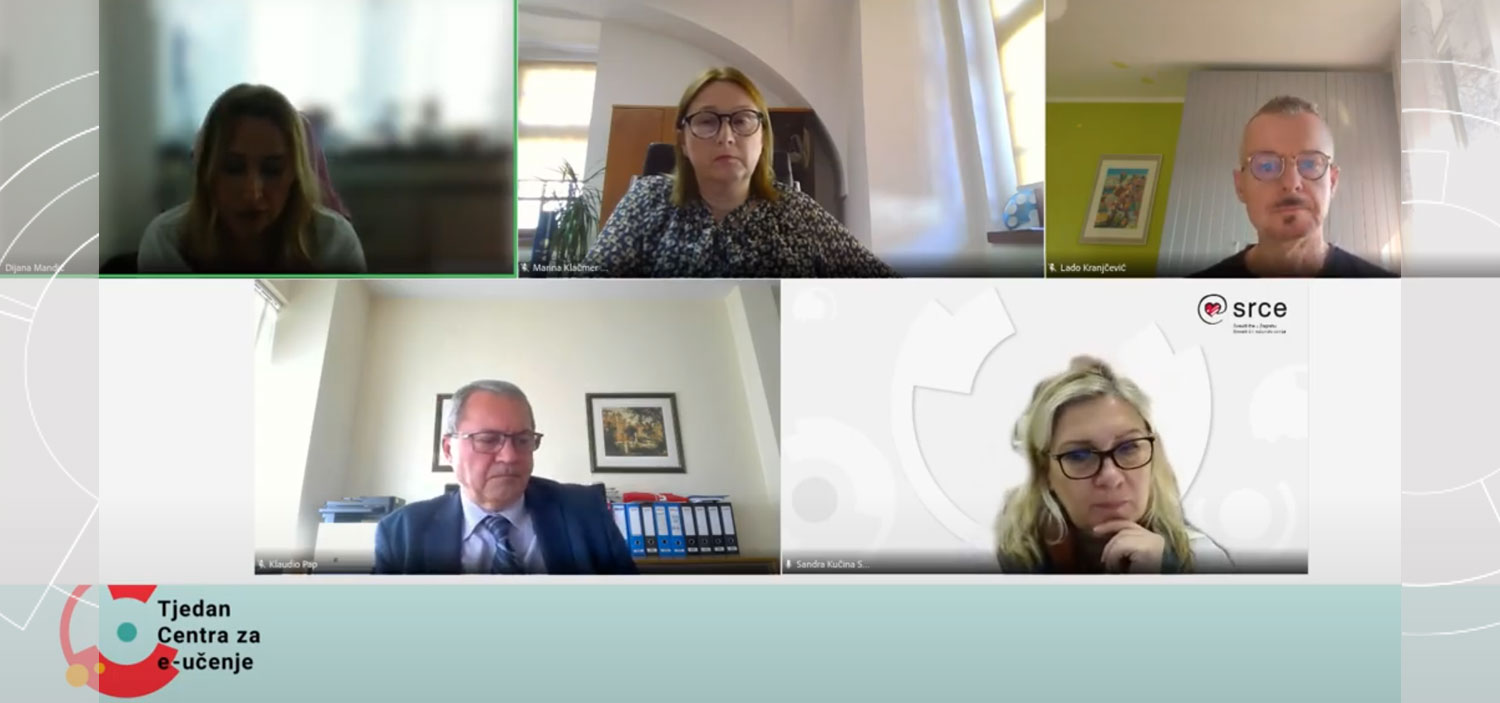
As part of the Week, an online panel titled “The Role of Institutional Leadership in Shaping Higher Education in the Post-Digital Era” was held on Friday, 10 October 2025. The panel brought together representatives of the academic community and decision-makers with the aim of exchanging views and perspectives on the future of education in a time when digital technologies are increasingly integrated into society and the education system.
The panel featured the following speakers:
-
Dijana Mandić, Director General of the Directorate for Higher Education, Ministry of Science, Education and Youth
-
Prof. Marina Klačmer Čalopa, Ph.D., Dean of the Faculty of Organization and Informatics, University of Zagreb
-
Prof. Lado Kranjčević, Ph.D., Dean of the Faculty of Engineering, University of Rijeka
-
Prof. Klaudio Pap, Ph.D., Dean of the Faculty of Graphic Arts, University of Zagreb
The panel was moderated by Assoc. Prof. Sandra Kučina Softić, Ph.D., Assistant Director of SRCE.
The discussion focused on the role of higher education institutions in ensuring the sustainability and resilience of education, as well as on a strategic approach to digital transformation and the integration of artificial intelligence into educational processes, while respecting ethical principles and ensuring quality. Particular emphasis was placed on the importance of a systemic approach to artificial intelligence, highlighting the need to link technological innovation with pedagogical, organisational and societal dimensions of education.
According to the participants, the development of digital competences of teachers and students is among the key priorities. Most panellists agreed that, for digital transformation, the development of clear institutional digitalisation policies is an even more important factor. Other key elements identified included monitoring the ethical and legal aspects of AI implementation, as well as investing in infrastructure and technology. The panellists presented concrete steps and activities undertaken at their institutions to support a systematic digital transformation and outlined how the Ministry of Science, Education and Youth monitors and supports this process within the higher education system.
As the most important aspects for the successful integration of artificial intelligence in higher education, participants highlighted the development of teachers’ digital and AI competences, the establishment of clear ethical and legal guidelines, the pedagogical integration of AI into teaching and curricula, and strong institutional leadership and support.
The panel concluded that the education system must adapt to the needs of the digital age and that the use of digital technologies and AI tools in education has become an integral part of the educational process. This requires the revision and development of new curricula, continuous professional development of teaching staff, and the adoption of policies and strategies that support digital transformation. Digital transformation is an ongoing process with no final endpoint, and institutional leadership plays a key role in ensuring that the education system remains resilient, modern, flexible, personalised and inclusive, without compromising quality.
As the central national e-infrastructure institution and a centre for education and support in the application of information and communication technologies, SRCE provides systematic support for digital transformation in the science and higher education system. Through its services, SRCE continuously monitors and encourages digital transformation, while also actively participating in discussions and activities on this topic to better inform the academic community and support the adaptation of higher education to the digital age.
A recording of the panel is available on the SRCE E-learning Centre website.
Throughout the Week, a total of ten webinars were held. For those who were unable to attend live, summaries and recordings are available on the SRCE E-learning Centre website.
