

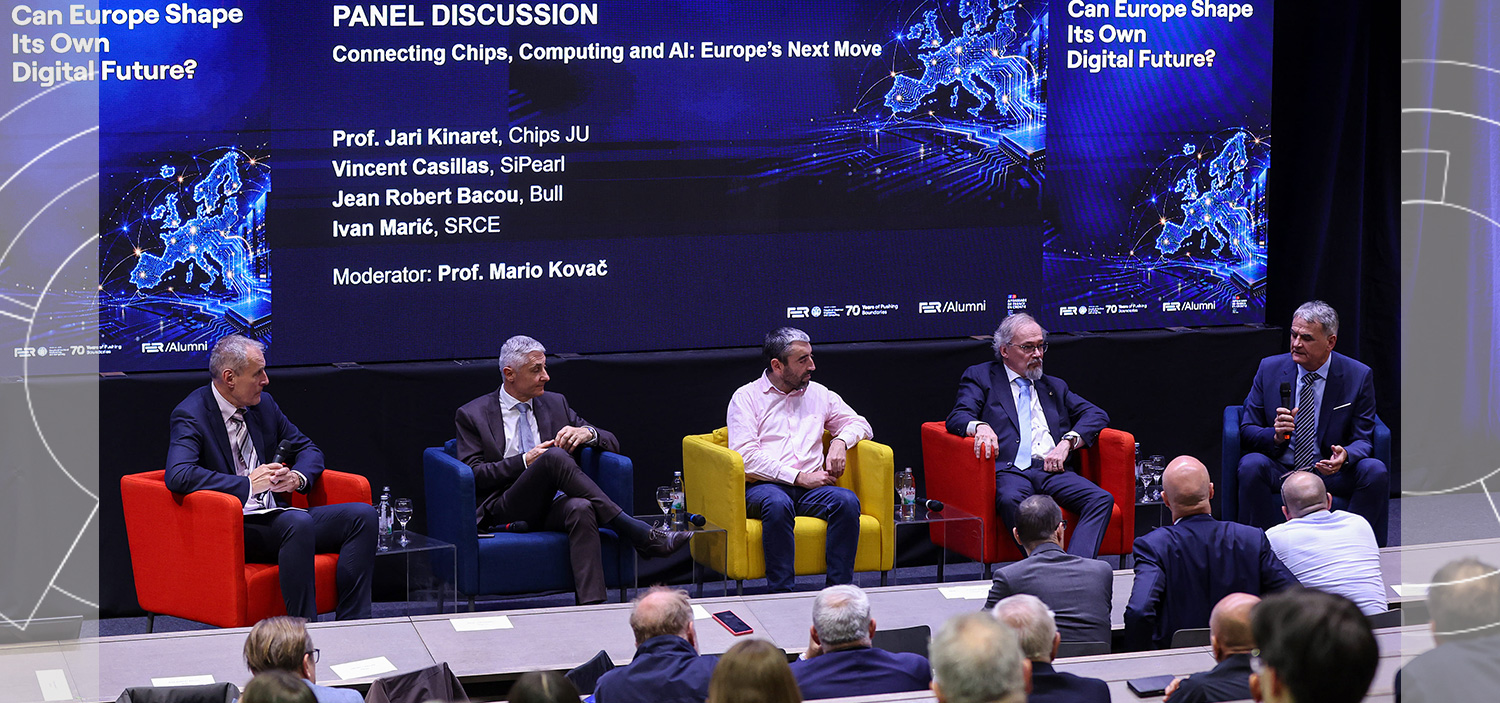
On Tuesday, FERConnect was held at the Faculty of Electrical Engineering and Computing, focusing on Europe's digital sovereignty under the title “Can Europe Shape Its Own Digital Future? European Perspectives and FER's Role in Strategic Partnerships: From Chips to High-Performance Computing and Artificial Intelligence”. The introductory presentation was delivered by Damir Habijan, Minister of Justice, Public Administration and Digital Transformation. Jari Kinaret, Executive Director of the European Chips Joint Undertaking (Chips JU); Vincent Casillas, CTO of SiPearl; Jean Robert Bacou, Head of R&D Projects in HPC, Artificial Intelligence and Quantum Technologies at Bull; and Ivan Marić, Director of SRCE, took part in the panel discussion. The panel was moderated by Mario Kovač, Ph.D., Director of FER's Research Centre for Computer Architectures and Applications.
Ivan Marić, Director of SRCE, presented his views on the key priorities and steps Croatian research institutions and companies should take to turn European initiatives in supercomputing, chips and artificial intelligence into business opportunities for the Croatian economy. In doing so, he drew on examples of SRCE's work in providing advanced computing services, coordinating the Croatian Competence Centre for HPC (HR HPC CC), building national data infrastructure and contributing to the development of the European Open Science Cloud (EOSC).
In the context of digital sovereignty and Europe's digital future, he emphasised that, alongside building infrastructure, investing in computing power and connecting to pan-European infrastructures and partnerships, it is essential to invest in people and develop expertise. This will enable them to participate on an equal footing in development and research and make full use of the opportunities offered by advanced digital technologies.
Using SRCE as an example, he stressed that networking at the European level and making use of the enormous technological investments Europe has made to achieve its digital goals are particularly important for Croatia. In this regard, special attention should also be paid to ensuring national financial support for Croatian institutions participating in such initiatives.
