

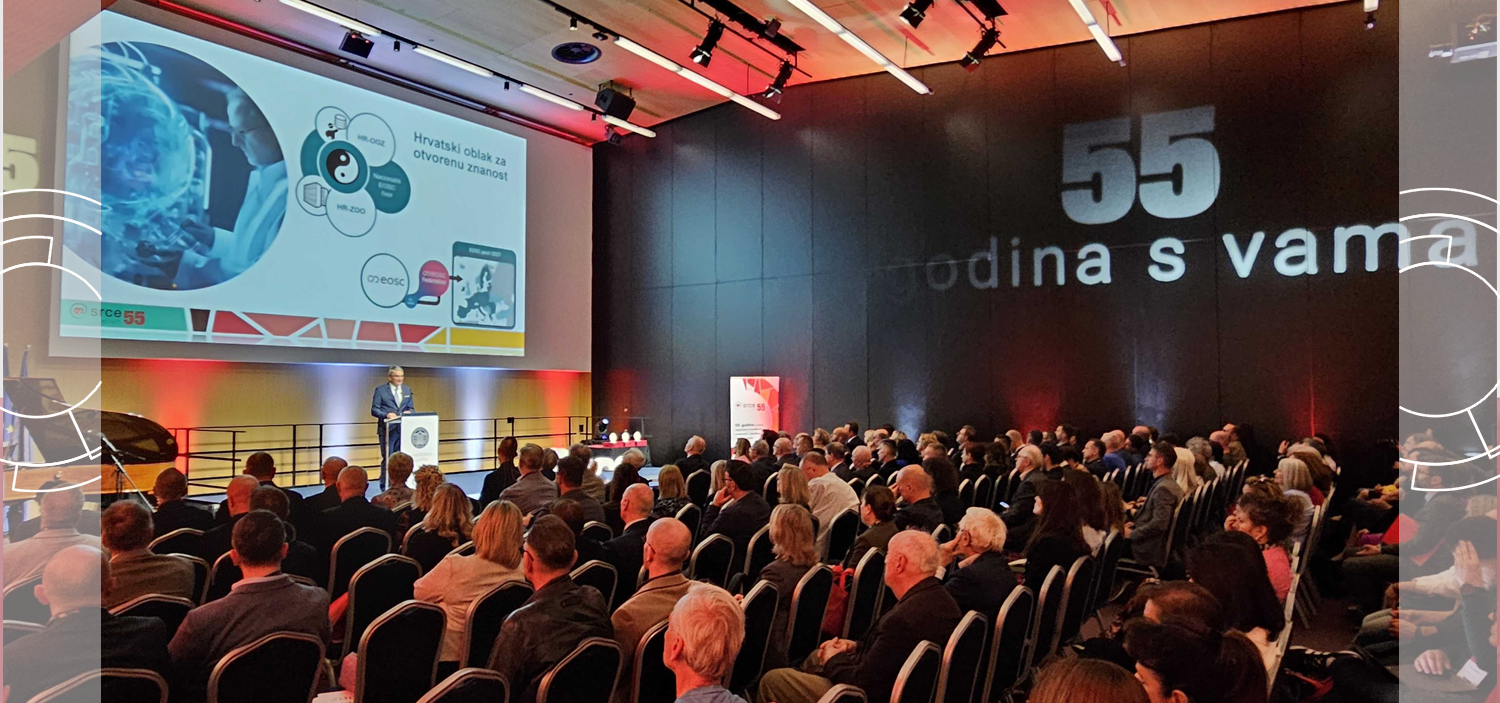
SRCE Ready to Meet New Challenges Brought by the AI-Driven Technological Revolution
SRCE celebrated its 55th anniversary with a ceremonial event held במסגרת the SRCE DEI 2026 Conference, taking place on 28 and 29 April at the University of Zagreb building, Radoslava Cimermana 88.
Founded on 29 April 1971 within the University of Zagreb, SRCE has continuously responded to the growing needs of the academic and research community by enabling knowledge exchange, connecting people, and systematically building the national shared e-infrastructure supporting science, higher education, and society as a whole.
SRCE was created from the idea that the university community needed reliable, expert, and accessible computing support. Over the decades, it has witnessed major technological revolutions and transformations — from the first mainframe computers and terminal networks to today’s digital transformation of higher education and science. Throughout this technological journey, the key driving force has always been people who believed technology could advance science and education.
For 55 years, SRCE has developed infrastructure and digital services supporting modern teaching, reliable research, and efficient data management. Through its systems, ideas, and expertise, SRCE enabled the introduction of the internet into the Croatian academic community, built national systems that simplify the work and daily life of students and professors, supported generations in developing digital and educational literacy, and created bridges between Croatian, European, and global digital spaces.
In his opening remarks, Stjepan Lakušić, Rector of the University of Zagreb, emphasized the importance of SRCE as a key infrastructure institution of the University:
“When the University of Zagreb founded SRCE back in 1971, it laid the foundation for what we today recognize as the digital transformation of higher education and science in Croatia. That decision was strategic, visionary, courageous, and far-sighted. Digital transformation today is no longer a matter of choice but a necessity, and SRCE plays a key role in this process by enabling organizational and developmental advances that make digital transformation possible.”
Additional welcome speeches were delivered by Dražen Lučanin on behalf of the City of Zagreb, Ignac Lovrek on behalf of the Croatian Academy of Sciences and Arts, and Dijana Mandić, representative of the Prime Minister of Croatia and Director of the Directorate for Higher Education at the Ministry of Science, Education and Youth.
Following the welcome addresses, SRCE Director Ivan Marić reflected on SRCE’s development and future direction:
“We have built a unique national e-infrastructure for Croatian universities and research institutes within the European context. We developed advanced digital services and resources that enabled digital education and top-level research, supported openness, contributed to hundreds of projects and initiatives, and empowered generations of students, professors, researchers, and IT professionals.”
He also emphasized that SRCE’s future priorities include artificial intelligence, cybersecurity, open science, open education, digital sovereignty, sustainable digital solutions, and inclusive access to knowledge.
The ceremony concluded with the presentation of special awards:
- in the category of distinguished individual from the community, the award was presented to Koraljka Kuzman Šlogar from the Institute of Ethnology and Folklore Research
- in the category of distinguished SRCE employee, the award was presented to Zoran Bekić
- in the category of distinguished institutions, the award was presented to the University of Zagreb
To mark the anniversary, SRCE also prepared a special exhibition titled “Memory of Time”, available to visitors of the SRCE DEI 2026 Conference on 28 and 29 April and later displayed at SRCE throughout the year.
The exhibition presents preserved technological heritage from SRCE — from line printers and magnetic tapes to one of the first personal computers, supercomputers, and the equipment used to establish Croatia’s first internet connection with the world. It features original computer equipment, archival photographs, historical logos, and newspaper articles documenting the development of technology and society.
