

National Infrastructure as a Key Pillar of Digital Sovereignty
The Third Croatian Competence Centre for High Performance Computing (HPC) Day was held on 11 and 12 November 2025, organised by SRCE, and brought together national and European experts in the field of high performance computing (HPC).
On Tuesday, 11 November, the workshop “HPC for Entrepreneurs” was held, offering participants an introduction to the fundamentals of HPC architecture and technologies, as well as available national and international HPC resources. Participants also gained hands-on experience working with SRCE’s advanced computing resources, including access to resources, data storage and preparation for processing, selection of programming environments, execution of user applications via job scheduling systems, and monitoring application execution and computing node performance.
The programme on Wednesday, 12 November, began with an overview of the HPC landscape in Europe and Croatia. As part of this session, Emir Imamagić, Head of the Advanced Computing Sector at SRCE, presented the results and achievements of the Croatian Competence Centre for HPC. Mladen Skelin from the European High Performance Computing Joint Undertaking (EuroHPC JU) outlined activities at the European level and reflected on Croatia’s participation in EuroHPC initiatives. Dr Panče Panov then presented the Slovenian AI Factory, sharing experiences gained during the launch of the initiative and the establishment of the AI Factory.
This was followed by four presentations showcasing practical applications of HPC. In her presentation “When the Public Helps Doctors: the AI4Health.Cro Challenge”, Dr Anja Barešić demonstrated the role of HPC in driving innovation in healthcare, drawing on experiences from a completed hackathon. In “Password Security Analysis”, Prof. Toni Perković, Ph.D., from the Faculty of Electrical Engineering, Mechanical Engineering and Naval Architecture of the University of Split, highlighted the importance of access to advanced computing resources for conducting password security research. Dr Inno Gatin from Cloud Towing Tank by In silico presented experiences using the Bura supercomputer in Rijeka and Vega in Slovenia for complex computational fluid dynamics calculations in ship hydrodynamics. In the presentation “An AI Model for Compliance and Cybersecurity Risk Assessment”, Stanko Cerin from Ostendo Consulting introduced a project focused on automating compliance audits and IT risk assessment processes, emphasising the importance of EuroHPC resources for delivering such projects within the EU.
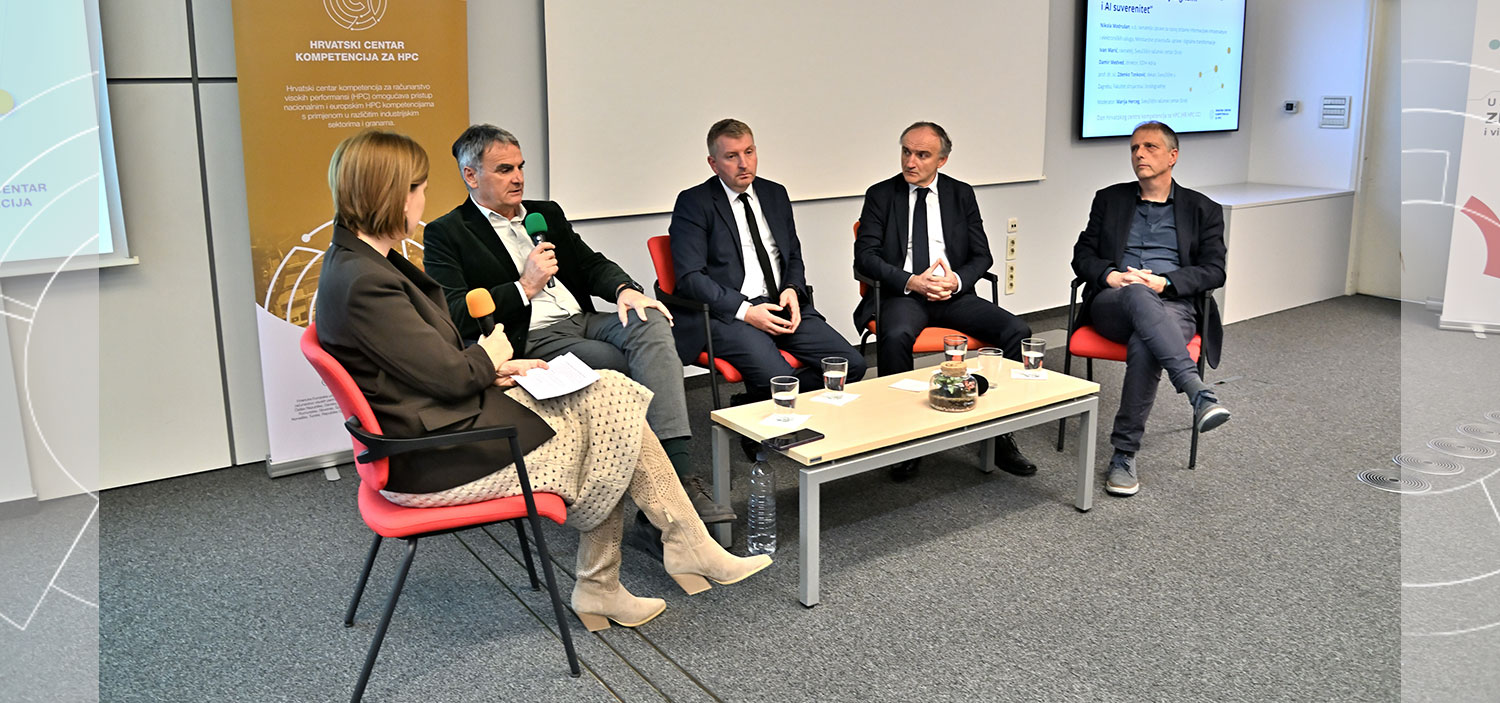
The central part of the event was a panel discussion titled “HPC for Stronger Digital and AI Sovereignty”, featuring Nikola Modrušan, Acting Director of the Directorate for the Development of State Information Infrastructure and Electronic Services at the Ministry of Justice, Public Administration and Digital Transformation; Prof. Zdenko Tonković, Ph.D., Dean of the Faculty of Mechanical Engineering and Naval Architecture, University of Zagreb; Ivan Marić, Director of the University Computing Centre (SRCE); and Damir Medved, Director of EDIH Adria.
The panelists agreed that the development and continuous upgrading of national HPC infrastructure are crucial for Croatia’s digital and AI sovereignty. They emphasised that national and European financial support must be aligned with long-term strategic planning and that reliance on short-term project-based funding should be reduced. Stronger and more permanent cooperation between the state, academia and industry is needed to ensure efficient use of resources and their transformation into innovation. Key challenges identified included a lack of expertise, insufficient knowledge transfer from academia to industry, perceptions of complexity, and limited awareness of available resources. Human capacity building and education in HPC and AI were highlighted as fundamental to long-term autonomy and competitiveness, with cybersecurity playing a significant role. Although Croatia missed the opportunity to establish a national AI factory in earlier calls, panelists agreed that efforts should continue towards creating a national centre that integrates infrastructure, data, expertise and industrial partners. With its established e-infrastructure for the academic and scientific community and extensive experience, SRCE is well positioned to play a leading role in this process, in line with the needs of the community.
