

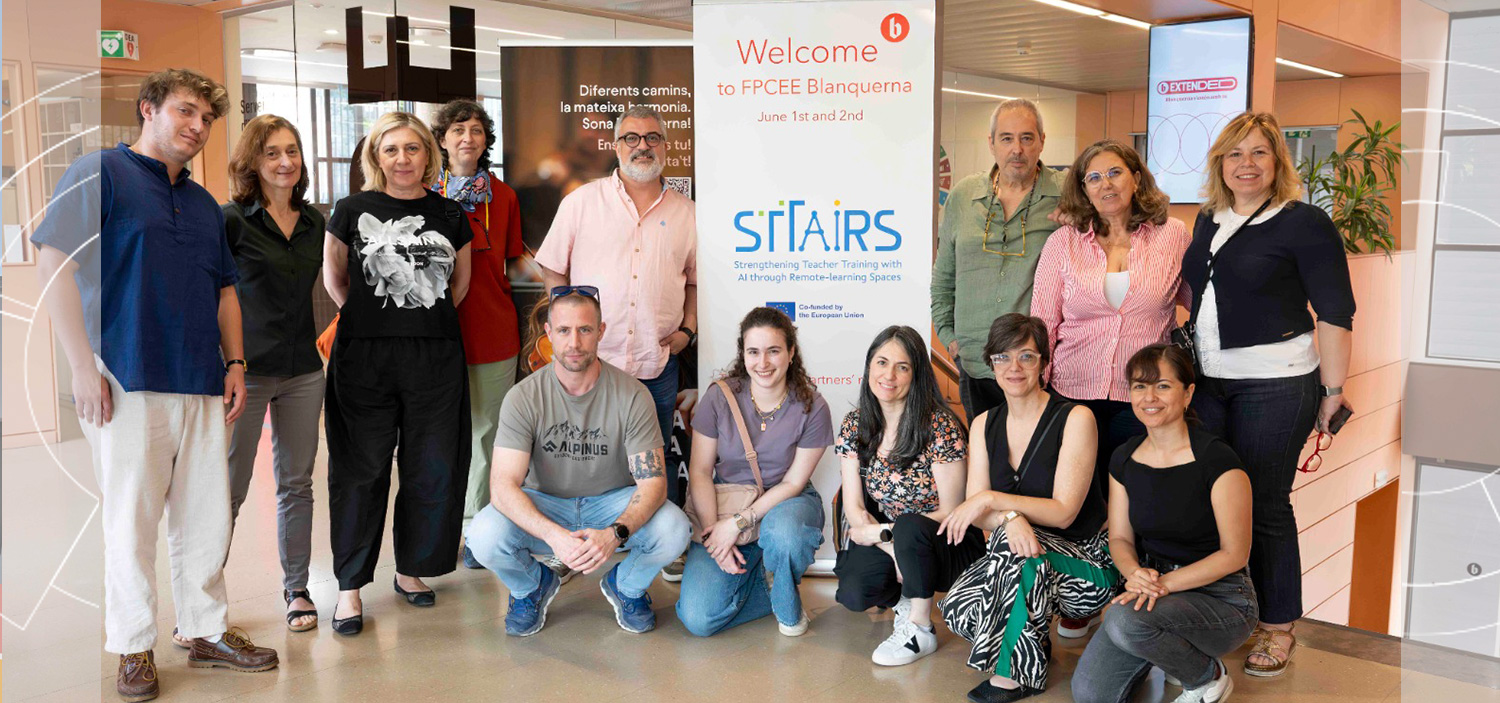
SRCE staff participated in the partner meeting of the Erasmus+ project Strengthening Teacher Training with AI through Remote-learning Spaces (STTAIRS) in Barcelona. They discussed the project’s progress and results achieved so far. The project aims to develop educational programs and systems for training teachers in the field of artificial intelligence, with a focus on increasing teacher satisfaction and well-being, improving their professional development (pedagogical and digital), and promoting inclusion and sustainability.
Through the development of specialized manuals, educational programs, and courses focused on integrating artificial intelligence into education, the project will enhance teachers’ competencies while ensuring sustainability, accessibility, and pedagogical alignment. It will also contribute to a more flexible, inclusive, and sustainable digital education ecosystem. The project coordinator is Centro Autonómico de Formación e Innovación (Spain). Along with SRCE, the partners are Universitat Ramon LLull Fundacio (Spain), Agrupamento de Escolas de Cister (Portugal), EUN Partnership AISBL (Belgium), and Özel Anabilim Ortaokulu (Turkey).
In this three-year project, SRCE leads the work package focused on establishing a virtual learning environment enhanced with artificial intelligence tools. This includes ensuring multilingual availability, adaptive learning functionalities, and support for personalized learning and digital well-being. SRCE is successfully implementing the activities in this package, drawing on its many years of experience in maintaining and improving virtual learning environments for higher education in Croatia.
The partner meeting took place on June 1 and 2, 2026, at Ramon LLull University. The meeting presented the results achieved so far. SRCE presented the established virtual learning environment, which is based on the Moodle e-learning system, along with an analysis of artificial intelligence tools and digital well-being. Based on this analysis, partners decided which tools to implement in the e-learning system.
SRCE also reported on workshops held for project partners aimed at increasing their digital competencies, as well as the results of the workshop evaluation by participants. The results show that participants from partner institutions are satisfied with the training and have improved their digital competencies.
During the meeting, the results of a survey on teachers’ knowledge and use of AI in the educational process were also presented. Initial findings indicate that teachers are increasingly using artificial intelligence and digital tools, but significant differences remain in access, confidence, and professional development. This highlights the need for more consistent and practical professional development and support for effective and ethical integration of artificial intelligence in education.
The partners defined further activities, and the first project results will be presented at the MoodleMoot Croatia 2026 conference, which will be held on June 11 and 12 at SRCE.
